

What Is Water Color Technique For Makeup?

An artist working on a watercolor using a round brush

Watercolor (American English) or watercolour (British English language; see spelling differences), also aquarelle (French: [akaʁɛl]; from Italian diminutive of Latin aqua "water"),[1] is a painting method in which the paints are made of pigments suspended in a water-based solution. Watercolor refers to both the medium and the resulting artwork. Aquarelles painted with water-soluble colored ink instead of modern water colors are chosen aquarellum atramento (Latin for "aquarelle fabricated with ink") past experts. All the same, this term has now tended to laissez passer out of use.[two] [iii]
The traditional and virtually mutual support—material to which the pigment is applied—for watercolor paintings is watercolor paper. Other supports include papyrus, bark papers, plastics, vellum, leather, fabric, wood, and watercolor canvas (coated with a gesso that is specially formulated for use with watercolours). Watercolor paper is frequently fabricated entirely or partially with cotton.[iv] This gives the surface the appropriate texture and minimizes baloney when wet.[5] Watercolor papers are usually common cold pressed papers, and gives amend texture and appearance with a GSM weight between 200 and 300. Watercolors are ordinarily translucent, and appear luminous because the pigments are laid down in a pure form with few fillers obscuring the pigment colors. Watercolors can also be fabricated opaque by adding Chinese white.
Watercolour pigment is an ancient form of painting. In East Asia, watercolor painting with inks is referred to equally brush painting or roll painting. In Chinese, Korean and Japanese painting it has been the ascendant medium, often in monochrome black or browns, often using inkstick or other pigments. India, Federal democratic republic of ethiopia and other countries have long watercolor painting traditions as well.
American artists in the early 19th century seemed to regard watercolor primarily as a sketching tool in preparation for the "finished" work in oil or engraving.[half-dozen]
History [edit]
Watercolor painting is extremely one-time, dating perhaps to the cave paintings of paleolithic Europe, and has been used for manuscript illustration since at least Egyptian times simply especially in the European Middle Ages. However, its continuous history equally an art medium begins with the Renaissance. The German Northern Renaissance artist Albrecht Dürer (1471–1528), who painted several fine botanical, wildlife, and landscape watercolors, is generally considered amongst the earliest exponents of watercolor. An important school of watercolor painting in Germany was led by Hans Bol (1534–1593) as part of the Dürer Renaissance.

Despite this early outset, watercolors were mostly used by Baroque easel painters simply for sketches, copies or cartoons (total-calibration design drawings). Notable early practitioners of watercolor painting were Van Dyck (during his stay in England), Claude Lorrain, Giovanni Benedetto Castiglione, and many Dutch and Flemish artists. However, botanical illustration and wild animals analogy maybe form the oldest and most important traditions in watercolor painting. Botanical illustrations became popular during the Renaissance, both equally hand-tinted woodblock illustrations in books or broadsheets and every bit tinted ink drawings on vellum or newspaper. Botanical artists have traditionally been some of the near exacting and achieved watercolor painters, and even today, watercolors—with their unique ability to summarize, clarify, and idealize in full color—are used to illustrate scientific and museum publications. Wildlife illustration reached its peak in the 19th century with artists such as John James Audubon, and today many naturalist field guides are nonetheless illustrated with watercolor paintings.
English school [edit]
Several factors contributed to the spread of watercolor painting during the 18th century, particularly in England. Among the elite and aristocratic classes, watercolor painting was one of the incidental adornments of a good education; mapmakers, military officers, and engineers valued it for its usefulness in depicting properties, terrain, fortifications, field geology, and for illustrating public works or commissioned projects. Watercolor artists were ordinarily taken on geological or archaeological expeditions, funded by the Lodge of Dilettanti (founded in 1733), to document discoveries in the Mediterranean, Asia, and the New Globe. These expeditions stimulated the demand for topographical painters, who churned out memento paintings of famous sites (and sights) along the K Tour to Italy that was undertaken by every stylish immature human being of the time.
In the belatedly 18th century, the English cleric William Gilpin wrote a series of hugely pop books describing his picturesque journeys throughout rural England, and illustrated them with self-fabricated sentimentalized monochrome watercolors of river valleys, ancient castles, and abandoned churches. This example popularized watercolors as a form of personal tourist journal. The confluence of these cultural, applied science, scientific, tourist, and amateur interests culminated in the commemoration and promotion of watercolor as a distinctly English language "national art". William Blake published several books of hand-tinted engraved poetry, provided illustrations to Dante's Inferno, and he also experimented with large monotype works in watercolor. Amid the many other significant watercolorists of this period were Thomas Gainsborough, John Robert Cozens, Francis Towne, Michael Angelo Rooker, William Pars, Thomas Hearne, and John Warwick Smith.

From the belatedly 18th century through the 19th century, the market for printed books and domestic fine art contributed substantially to the growth of the medium. Watercolors were used as the basic document from which collectible landscape or tourist engravings were adult, and manus-painted watercolor originals or copies of famous paintings contributed to many upper grade art portfolios. Satirical broadsides by Thomas Rowlandson, many published past Rudolph Ackermann, were also extremely pop.
The 3 English language artists credited with establishing watercolor as an independent, mature painting medium are Paul Sandby (1730–1809), often called the "male parent of the English watercolor"; Thomas Girtin (1775–1802), who pioneered its utilize for big format, romantic or picturesque landscape painting; and Joseph Mallord William Turner (1775–1851), who brought watercolor painting to the highest pitch of power and refinement, and created hundreds of superb historical, topographical, architectural, and mythological watercolor paintings. His method of developing the watercolor painting in stages, starting with large, vague colour areas established on wet paper, then refining the paradigm through a sequence of washes and glazes, permitted him to produce big numbers of paintings with "workshop efficiency" and made him a multimillionaire, partly by sales from his personal art gallery, the first of its kind. Amid the important and highly talented contemporaries of Turner and Girtin were John Varley, John Sell Cotman, Anthony Copley Fielding, Samuel Palmer, William Havell, and Samuel Prout. The Swiss painter Abraham-Louis-Rodolphe Ducros was also widely known for his large format, romantic paintings in watercolor.
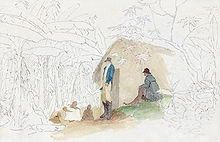
An unfinished watercolor by William Berryman, created betwixt 1808 and 1816, using watercolor, ink, and pencil. The use of partial pigmentation draws attending to the central subject.
The confluence of amateur activity, publishing markets, middle class fine art collecting, and 19th-century technique led to the formation of English language watercolor painting societies: the Society of Painters in Water Colours (1804, now known as the Imperial Watercolour Order) and the New Water Color Society (1832, now known as the Royal Institute of Painters in Water Colours). (A Scottish Society of Painters in Water Colour was founded in 1878, now known as the Royal Scottish Society of Painters in Watercolour.) These societies provided almanac exhibitions and buyer referrals for many artists. They as well engaged in petty status rivalries and artful debates, particularly betwixt advocates of traditional ("transparent") watercolor and the early on adopters of the denser colour possible with body colour or gouache ("opaque" watercolor). The late Georgian and Victorian periods produced the zenith of the British watercolor, among the most impressive 19th-century works on paper,[7] due to artists Turner, Varley, Cotman, David Cox, Peter de Wint, William Henry Hunt, John Frederick Lewis, Myles Birket Foster, Frederick Walker, Thomas Collier, Arthur Melville and many others. In item, the graceful, lapidary, and atmospheric watercolors ("genre paintings") by Richard Parkes Bonington created an international fad for watercolor painting, particularly in England and France in the 1820s.
The popularity of watercolors stimulated many innovations, including heavier and more sized wove papers, and brushes (called "pencils") manufactured expressly for watercolor. Watercolor tutorials were first published in this flow by Varley, Cox, and others, establishing the step-by-step painting instructions that still characterize the genre today; The Elements of Drawing, a watercolor tutorial by English art critic John Ruskin, has been out of impress only one time since it was first published in 1857. Commercial brands of watercolor were marketed and paints were packaged in metal tubes or as dry cakes that could be "rubbed out" (dissolved) in studio porcelain or used in portable metal paint boxes in the field. Breakthroughs in chemistry made many new pigments bachelor, including synthetic ultramarine blue, cobalt blue, viridian, cobalt violet, cadmium yellow, aureolin (potassium cobaltinitrite), zinc white, and a wide range of carmine and madder lakes. These pigments, in turn, stimulated a greater utilise of colour with all painting media, but in English language watercolors, specially by the Pre-Raphaelite Brotherhood.

U.s.a. [edit]
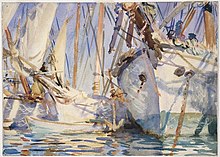
Watercolor painting also became pop in the United States during the 19th century; outstanding early practitioners included John James Audubon, as well as early on Hudson River School painters such as William H. Bartlett and George Harvey. Past mid-century, the influence of John Ruskin led to increasing interest in watercolors, particularly the use of a detailed "Ruskinian" way by such artists as John Westward. Hill Henry, William Trost Richards, Roderick Newman, and Fidelia Bridges. The American Social club of Painters in Watercolor (at present the American Watercolor Society) was founded in 1866. Late-19th-century American exponents of the medium included Thomas Moran, Thomas Eakins, John LaFarge, John Vocalizer Sargent, Childe Hassam, and, preeminently, Winslow Homer.
Europe [edit]
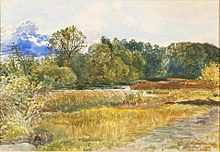
Watercolor was less pop in Continental Europe. In the 18th century, gouache was an important medium for the Italian artists Marco Ricci and Francesco Zuccarelli, whose landscape paintings were widely collected.[8] Gouache was used past a number of artists in France as well. In the 19th century, the influence of the English language school helped popularize "transparent" watercolor in France, and information technology became an of import medium for Eugène Delacroix, François Marius Granet, Henri-Joseph Harpignies, and the satirist Honoré Daumier. Other European painters who worked oft in watercolor were Adolph Menzel in Germany and Stanisław Masłowski in Poland.

The adoption of brightly colored, petroleum-derived aniline dyes (and pigments compounded from them), which all fade chop-chop on exposure to lite, and the efforts to properly conserve the 20 thousand J. M. W. Turner paintings inherited by the British Museum in 1857, led to a negative reevaluation of the permanence of pigments in watercolor.[ citation needed ] This caused a abrupt turn down in their condition and market value. Nevertheless, isolated practitioners connected to prefer and develop the medium into the 20th century. Paul Signac created landscape and maritime watercolors, and Paul Cézanne adult a watercolor painting style consisting entirely of overlapping small glazes of pure colour.
20th and 21st centuries [edit]
Amidst the many 20th-century artists who produced important works in watercolor were Wassily Kandinsky, Emil Nolde, Paul Klee, Egon Schiele, and Raoul Dufy. In America, the major exponents included Charles Burchfield, Edward Hopper, Georgia O'Keeffe, Charles Demuth, and John Marin (80% of his total work is watercolor). In this menses, American watercolor painting oft imitated European Impressionism and Post-Impressionism, simply significant individualism flourished in "regional" styles of watercolor painting from the 1920s to 1940s. In particular, the "Cleveland School" or "Ohio Schoolhouse" of painters centered around the Cleveland Museum of Art, and the California Scene painters were oft associated with Hollywood blitheness studios or the Chouinard Art Constitute (now California Found of the Arts). The California painters exploited their land's varied geography, Mediterranean climate, and "automobility" to reinvigorate the outdoor or "plein air" tradition. The most influential among them were Phil Dike, Millard Sheets, Rex Brandt, Dong Kingman, and Milford Zornes. The California Water Color Society, founded in 1921 and later renamed the National Watercolor Lodge, sponsored important exhibitions of their work. The largest watercolor in the world at the moment (at 9 feet (three grand) alpine and 16 ft (5 m) wide) is Building half-dozen Portrait: Interior. [9] Produced past American creative person Barbara Prey on commission for MASS MoCA,[x] the work tin can be seen at MASS MoCA's Robert W. Wilson Building.[xi]
Although the ascension of abstract expressionism, and the trivializing influence of apprentice painters and advertising- or workshop-influenced painting styles, led to a temporary decline in the popularity of watercolor painting afterward c. 1950, watercolors go along to exist utilized by artists like Martha Burchfield, Joseph Raffael, Andrew Wyeth, Philip Pearlstein, Eric Fischl, Gerhard Richter, Anselm Kiefer, and Francesco Clemente. In Spain, Ceferí Olivé created an innovative way followed by his students, such as Rafael Alonso López-Montero and Francesc Torné Gavaldà. In Mexico, the major exponents are Ignacio Barrios, Edgardo Coghlan, Ángel Mauro, Vicente Mendiola, and Pastor Velázquez. In the Canary Islands, where this pictorial technique has many followers, at that place are stand-out artists such as Francisco Bonnín Guerín, José Comas Quesada, and Alberto Manrique.
Watercolor paint [edit]
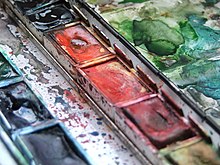
Watercolor paint consists of four main ingredients: a pigment; gum standard arabic every bit a binder to hold the paint in break; additives like glycerin, ox gall, honey, and preservatives to modify the viscosity, hiding, immovability or colour of the pigment and vehicle mixture; and evaporating h2o, as a solvent used to thin or dilute the paint for application.
The more general term watermedia refers to any painting medium that uses water every bit a solvent and that can be applied with a castor, pen, or sprayer. This includes most inks, watercolors, temperas, caseins, gouaches, and modern acrylic paints.
The term "watercolor" refers to paints that utilize water-soluble, complex carbohydrates every bit a binder. Originally (in the 16th to 18th centuries), watercolor binders were sugars and/or hide glues, simply since the 19th century, the preferred binder is natural gum arabic, with glycerin and/or love as additives to amend plasticity and solubility of the binder, and with other chemicals added to meliorate product shelf life.
The term "bodycolor" refers to paint that is opaque rather than transparent. Information technology usually refers to opaque watercolor, known as gouache.[12] Modern acrylic paints use an acrylic resin dispersion as a binder.
Commercial watercolors [edit]
Watercolor painters before the turn of the 18th century had to brand paints themselves using pigments purchased from an apothecary or specialized "colorman", and mixing them with gum arabic or some other binder. The earliest commercial paints were small, resinous blocks that had to be wetted and laboriously "rubbed out" in water to obtain a usable color intensity. William Reeves started his business organization as a colorman effectually 1766. In 1781, he and his brother, Thomas Reeves, were awarded the Silver Palette of the Society of Arts, for the invention of the moist watercolor paint-cake, a fourth dimension-saving convenience, introduced in the "golden age" of English watercolor painting. The "cake" was immediately soluble when touched by a wet brush.
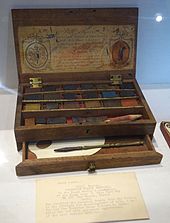
Modernistic commercial watercolor paints are available in two forms: tubes or pans. The majority of paints sold today are in collapsible small-scale metal tubes in standard sizes and formulated to a consistency like to toothpaste by being already mixed with a certain water component. For use, this paste has to be farther diluted with water. Pan paints (actually modest stale cakes or bars of pigment in an open plastic container) are commonly sold in two sizes, full pans and one-half pans.
Owing to modern industrial organic chemistry, the variety, saturation, and permanence of artists' colors bachelor today has been vastly improved. Since 2014, Golden Artist Colors makes a heavily pigmented line chosen QoR watercolors ('Quality of Results') that uses Aquazol as a binder. Right and non-toxic principal colors are now nowadays through the introduction of hansa yellow, phthalo blue and quinacridone (PV 122). From such a set of three colors, in principle all others tin be mixed, every bit in a classical technique no white is used. The modern development of pigments was non driven by artistic need. The art materials manufacture is too small to exert any market leverage on global dye or pigment manufacture. With rare exceptions such equally aureolin, all modern watercolor paints use pigments that have a wider industrial utilize. Paint manufacturers buy, by industrial standards very small, supplies of these pigments, mill them with the vehicle, solvent, and additives, and package them. The milling process with inorganic pigments, in more expensive brands, reduces the particle size to improve the color flow when the pigment is applied with water.
Transparency [edit]
In the partisan debates of the 19th-century English fine art world, gouache was emphatically contrasted to traditional watercolors and denigrated for its high hiding power or lack of "transparency"; "transparent" watercolors were exalted. The aversion to opaque pigment had its origin in the fact that well into the 19th century lead white was used to increase the covering quality. That paint tended to presently discolor into black under the influence of sulphurous air pollution, totally ruining the artwork.[13] The traditional merits that "transparent" watercolors gain "luminosity" because they function like a pane of stained drinking glass laid on newspaper—the color intensified considering the light passes through the pigment, reflects from the paper, and passes a second time through the paint on its way to the viewer—is imitation. Watercolor paints typically exercise non form a cohesive pigment layer, as do acrylic or oil paints, but simply besprinkle pigment particles randomly across the paper surface; the transparency is caused by the paper existence visible between the particles.[fourteen] Watercolors may appear more vivid than acrylics or oils considering the pigments are laid down in a purer class, with few or no fillers (such equally kaolin) obscuring the paint colors. Typically, near or all of the gum folder will be absorbed past the paper, preventing the folder from changing the visibility of the pigment.[xiv] The glue existence absorbed does non decrease merely increase the adhesion of the pigment to the paper, as its particles will so penetrate the fibres more easily. In fact, an important function of the gum is to facilitate the "lifting" (removal) of color, should the artist want to create a lighter spot in a painted area.[14] Furthermore, the gum prevents flocculation of the pigment particles.[14]
Run into also [edit]
- Acrylic painting techniques
- History of painting
- Ink wash painting
- Category:Watercolorists
Notes [edit]
- ^ "aquarelle". Oxford English language Lexicon (Online ed.). Oxford University Printing. (Subscription or participating institution membership required.)
- ^ Ling, Roger (1991). Roman Painting. Cambridge Academy Press.
- ^ Waterhouse, Ellis Kirkham (1994). Painting in Britain, 1530 to 1790. Yale Academy Printing.
- ^ Vloothuis, Johannes (2017-07-14). "Understanding the Different Grades of Watercolor Newspaper". Artists Network. Retrieved 2018-x-03 .
- ^ "Watercolor Newspaper: How to Choose the Right Paper for Use with Watercolors". fine art-is-fun.com. Art Is Fun. Archived from the original on 2015-10-07. Retrieved 2015-x-06 .
- ^ "What Is Watercolor?". collectorsguide.com. The Collector'southward Guide.
- ^ Reynolds, Graham (1992), Watercolours, A Curtailed History, London: Thames and Hudson, p. 102
- ^ Brown, David Blayney. "Watercolour." Grove Fine art Online. Oxford Art Online. Oxford University Press. Retrieved Apr 26, 2014.
- ^ Nalewicki, Jennifer. "The Story Backside the Globe's Largest Watercolor Painting". Smithsonian . Retrieved 2018-07-01 .
- ^ "The World'due south Largest Watercolor Goes on Display at MASS MoCA". Creators. 2017-05-30. Retrieved 2018-07-01 .
- ^ "Barbara Ernst Prey Building 6 Portrait: Interior". MASS MoCA . Retrieved 2018-07-01 .
- ^ The Oxford Dictionary of Art and Artists, Ian Chilvers, Oxford University Printing United states of america, 2009
- ^ D. Kraaijpoel & C. Herenius. (2007) Het kunstschilderboek — handboek voor materialen en technieken, Cantecleer, p. 187
- ^ a b c d D. Kraaijpoel & C. Herenius. (2007) Het kunstschilderboek — handboek voor materialen en technieken, Cantecleer, p. 183
References [edit]
History [edit]
- Andrew Wilton & Anne Lyles. The Swell Age of British Watercolours (1750–1880). Prestel, 1993. ISBN 3-7913-1254-5
- Anne Lyles & Robin Hamlyn. British watercolours from the Oppé Collection. Tate Gallery Publishing, 1997. ISBN 1-85437-240-viii
- Christopher Finch. American Watercolors. Abbeville Press, 1991. ASIN B000IBDWGK
- Christopher Finch. Nineteenth-Century Watercolors. Abbeville Printing, 1991. ISBN ane-55859-019-half dozen
- Christopher Finch. Twentieth-Century Watercolors. Abbeville Press, 1988. ISBN 0-89659-811-10
- Eric Shanes. Turner: The Great Watercolours. Royal Academy of Arts, 2001. ISBN 0-8109-6634-4
- Martin Hardie. Water-Colour Painting in U.k. (3 volumes: I. The Eighteenth Century; Two. The Romantic Menstruum; Iii. The Victorian Menstruum.). Batsford, 1966–1968. ISBN ane-131-84131-Ten
- Michael Clarke. The Tempting Prospect: A Social History of English language Watercolours. British Museum Publications, 1981. ASIN B000UCV0XO
- Moore, Sean. Ultimate Visual Dictionary. Dorling Kindersley, 1994. ISBN 0-7513-1050-half-dozen
Tutorials and Technique [edit]
- Rex Brandt. The Winning Means of Watercolor: Bones Techniques and Methods of Transparent Watercolor in Twenty Lessons. Van Nostrand Reinhold, 1973. ISBN 0-442-21404-ix
- David Dewey. The Watercolor Book: Materials and Techniques for Today's Artist. Watson-Guptill, 1995. ISBN 0-8230-5641-4
- Donna Seldin Janis. Sargent Abroad: Figures and Landscapes. Abbeville Press; 1st edition (Oct 1997). ISBN 978-0-7892-0384-7.
- Charles LeClair. The Art of Watercolor (Revised and Expanded Edition). Watson-Guptill, 1999. ISBN 0-8230-0292-6
- Royal Watercolour Social club. The Watercolour Skillful. Cassell Illustrated, 2004. ISBN 1-84403-149-seven
- John Ruskin. The Elements of Drawing [1857]. Watson-Guptill, 1991. ISBN 0-8230-1602-1 (Reprints from other publishers are also available.)
- Pip Seymour. Watercolour Painting: A Handbook for Artists. Lee Printing, 1997. ISBN 0-9524727-4-0
- Stan Smith. Watercolor: The Complete Class. Reader'south Assimilate, 1995. ISBN 0-89577-653-seven
- Curtis Tappenden. Foundation Course: Watercolour. Cassell Illustrated, 2003. ISBN 1-84403-082-2
- Edgar A. Whitney. Complete Guide to Watercolor Painting. Watson-Guptill, 1974. [Dover Edition ISBN 0-486-41742-5]
Materials [edit]
- Ian Sidaway. The Watercolor Artist'south Paper Directory. Due north Lite, 2000. ISBN i-58180-034-7
- Jacques Turner. Brushes: A Handbook for Artists and Artisans. Blueprint Press, 1992. ISBN 0-8306-3975-6
- Sylvie Turner. The Book of Fine Newspaper. Thames & Hudson, 1998. ISBN 0-500-01871-5
- Michael Wilcox. The Wilcox Guide To The Best Watercolor Paints. Schoolhouse of Color Publications, 2000. ISBN 978-0-9679628-0-i
External links [edit]
- American Watercolor Social club
- National Watercolor Social club (U.s.a.)
- Belgian Watercolor Institute
- "Watercolour Painting". Paintings & Drawings. Victoria and Albert Museum. Retrieved 2007-08-21 .
- http://watercolor.net/history-overview/
- http://www.handprint.com/HP/WCL/water.html
https://world wide web.creativelive.com/blog/watercolor-painting-for-beginners/

What Is Water Color Technique For Makeup?,
Source: https://en.wikipedia.org/wiki/Watercolor_painting
Posted by: gonzalezhicustant91.blogspot.com
0 Response to "What Is Water Color Technique For Makeup?"
Post a Comment